
Thermal Inactivation Kinetics for Long-Term Frozen Produce Quality
Before vegetables enter IQF (Individually Quick Frozen) fluid bed tunnels, active endogenous enzymes must be inactivated. Without blanching, peroxidase and lipoxygenase will continue to break down flavor, texture, and bright chlorophyll pigments even at -18°C storage temperatures.
Q: Why is Two-Stage Hydro-Cooling crucial immediately after blanching?
Leaving blanched vegetables warm causes overcooking and leaching of vitamins. A two-stage hydro-cooler first drops the temperature from ~90°C to 20°C using ambient recirculated water, followed immediately by 0°C–2°C ice-water counter-current spray bringing produce core temperature below 5°C within 120 seconds, locking in crunchiness.
Industrial Peeling Technologies: Yield, Environmental Footprint & Line Speed
Peeling root crops (potatoes, carrots, beets, sweet potatoes) represents a delicate trade-off between flesh loss, operating chemical costs, and wastewater effluent loads.
Q: Why is Mechanical Brush Peeling dominant in medium-scale packing plants?
While steam peeling offers the lowest peel loss for massive French-fry plants (>10 tons/h), high-pressure steam boilers require substantial capital outlay. HADOF multi-roller brush peeling machines offer an affordable, modular, and 100% chemical-free continuous solution that eliminates hazardous chemical storage and neutralization costs.
Architectural & Engineering Fundamentals for Sanitary Food Facilities
Contamination prevention in modern ready-to-eat (RTE) fruit and salad manufacturing begins on the architectural CAD drawing board. Proper physical zoning and directional flow ensure that pathogens from field soil cannot enter sterilized packaging cleanrooms.
The Four Hygienic Zones of a Processing Plant
- Zone 1 – Raw Intake & Dry De-soiling: Negative air pressure intake area.
- Zone 2 – Primary Washing & Sizing: Wet dirt removal with physical stainless washdown barriers.
- Zone 3 – Precision Cutting & Sanitization: High-care cleanroom with positive pressure (+15 Pa) and HEPA air filtration.
- Zone 4 – Spin-Drying & MAP Packaging: Low-temperature controlled environment (≤ 10°C).
The Mechanics of Three-Dimensional Produce Cutting
Precision sizing is vital for canned foods, ready meals, frozen vegetable medleys, and dehydrated soup ingredients. Uniform cut geometry ensures identical heat transfer during blanching and freezing, preventing overcooked or raw batches.
Q1: How does a 3D Dicing Machine coordinate slicing, cross-cutting, and dicing knives?
Unlike simple guillotine choppers, industrial 3D dicers process produce in three continuous orthogonal cutting stages: centrifugal slicing against outer drums, high-speed circular disc strip cutting, and transverse reel dicing releasing cubes from 3mm to 25mm.
Q2: How do engineers prevent cellular moisture leakage during high-speed cutting?
Cellular rupture occurs when blunt knives compress produce beyond its elastic limit. HADOF dicers incorporate German/Taiwanese high-carbon alloy blades (440C/9Cr18MoV) cryogenically treated to HRC 58–60 with calibrated knife clearance to 0.05–0.1mm, ensuring pure shear cutting without frictional heat or bruising, reducing juice runoff by over 80%.
Optimizing Extraction Efficiency in Commercial Juice & Puree Lines
In high-capacity juice extraction, yield percentage per ton of raw fruit directly governs operational profitability. Selecting between a continuous Belt Filter Press and a Tapered Screw Extractor depends on fruit fiber structure, seed fragility, and viscosity.
Q1: When is a Continuous Belt Press the superior extraction choice?
Belt presses excel with crushed pome fruits (apples, pears) and berries. Mash travels across decreasing-diameter roller drums under pneumatic squeezing up to 8 bar, delivering yields between 75% and 85% with minimal seed maceration.
Q2: Why are Tapered Screw Press Juicers preferred for fibrous vegetables and ginger?
For high-fiber crops like ginger, pineapple, and leafy herbs, screw extractors utilize a variable-pitch flight screw rotating inside a wedge-wire screen basket with a pneumatic backpressure cone regulating cake dryness.
Hygienic Design & Sanitation Standards in Commercial Food Engineering
Cross-contamination and allergen retention represent the greatest operational risks in commercial food processing. Modern equipment design must adhere strictly to EHEDG (European Hygienic Engineering & Design Group) and 3-A Sanitary Standards.
Q1: What structural design rules prevent bacterial trap points in processing machinery?
All frames and tanks fabricated by HADOF follow sanitary food engineering fundamentals: continuous TIG welding seams ground flat to Ra <= 0.8um, self-draining sloped tank floors, and stand-off component mounting preventing water entrapment.
Q2: What is the recommended 5-Step CIP Procedure for Washing Lines?
- Step 1 – Coarse Pre-Rinse: Flush all tanks and belts with 40–50°C clean water for 5–8 minutes.
- Step 2 – Alkaline Detergent Wash: Recirculate 1.0%–1.5% NaOH solution at 65–70°C for 15 minutes.
- Step 3 – Intermediate Water Rinse: Flush with potable water until pH returns to neutral.
- Step 4 – Acid Descaling Wash: Circulate 0.5%–1.0% Nitric or Phosphoric acid at 55–60°C for 10 minutes.
- Step 5 – Final Sanitization: Recirculate peracetic acid (150–200 ppm) for 5 minutes prior to startup.
Understanding Industrial Washing Technologies for Commercial Food Processing
Washing is the critical first sanitation stage in any fresh-cut salad, freezing (IQF), or dehydration processing line. The choice of washing technology directly dictates microbial reduction efficiency, water consumption, and physical damage to produce.
Q1: When should you select an Air Bubble Washing Machine?
Air bubble washing utilizes a high-pressure blower that forces clean air through immersed diffuser pipes, generating vigorous boiling-like turbulence. This hydraulic action gently tumbles lightweight fruits and leafy vegetables (such as spinach, lettuce, berries, and herbs) without mechanical friction. Sand, soil, and heavy foreign particles settle into the bottom sedimentation cone, while surface bugs and leaves are skimmed off by circulating overflow filtration.
Q2: How does Vortex Hydraulic Flume Washing differ from Bubble Washing?
Vortex washing lines combine forward water currents with spiral spiral vortex flow. Fruits and cut vegetables travel through a continuous stainless flume where adjustable water jets produce a 360-degree helical motion. This ensures complete multi-angle sanitization, making it ideal for cut lettuce, diced onions, and sliced peppers where produce surfaces must contact water-soluble sanitizing agents (such as chlorine dioxide or peracetic acid) for a strictly calibrated dwell time (typically 60 to 90 seconds).
Q3: What makes Brush Roller Washers essential for Root Vegetables?
For root crops such as potatoes, carrots, ginger, and cassava, surface soil is often compacted into crevices and root eyes. Brush washing machines employ 9 to 13 counter-rotating wave-cut nylon brushes. Soft DuPont nylon brushes (0.2–0.3mm) provide deep cleaning without deskinning, whereas stiff emery-coated or abrasive bristles achieve continuous peeling and deskinning under high-pressure water spray manifolds.
Industrial Drying Technologies for Fruits, Vegetables, and Bio-Produits
Drying is one of the oldest and most versatile food preservation methods. However, in modern export food manufacturing, processors must weigh capital investment, operating costs, and final market pricing when choosing between Vacuum Freeze Drying (FD) and Convective Hot Air Dehydration (AD).
Q1: What is the physical mechanism of Freeze Drying (Lyophilization)?
Freeze drying relies on the thermodynamic principle of ice sublimation under vacuum. Fresh produce is first pre-frozen in blast freezers to below its eutectic point (-35°C to -45°C) to lock free moisture into solid ice crystals. The material is then transferred to a vacuum drying chamber where pressure is reduced below the triple point of water (611.65 Pa). Heating plates supply sublimation heat, transitioning water directly from solid ice to water vapor without passing through the liquid phase.
Q2: What are the sensory and nutritional differences between FD and AD products?
Freeze drying retains 92%–97% of vitamins, natural colors, and 100% of physical volume with instant cold-water rehydration, making it ideal for high-margin healthy snacks and soup ingredients. Convective hot air drying operates at lower capital cost but incurs thermal degradation and shrinkage, best suited for industrial food ingredient bases.
Key Challenges in Fresh-Cut Vegetable & Fruit Production
Once vegetables and fruits undergo peeling and mechanical cutting, cellular integrity is disrupted. Vacuolar phenolic substrates come into contact with cytoplasmic polyphenol oxidase (PPO) in the presence of oxygen, triggering rapid enzymatic browning and accelerating quality degradation.
Q1: How does mechanical blade sharpness affect product shelf life?
Dull cutting tools crush and rupture cell walls instead of creating clean planar shears. Crushed cells leak intracellular fluids, releasing sugars and enzymes that fuel rapid microbial proliferation and browning. HADOF precision cutters utilize ultra-hardened SUS440C stainless rotary blades sharpened to a microscopic radius of less than 0.02mm, reducing cellular cell-crush rates by over 75% compared to conventional stamped blades.
Q2: Why is chilled wash water (0–4°C) essential during the washing stage?
Water temperature is the single most critical environmental parameter in ready-to-eat salad operations. Chilled washing water accomplishes two vital goals simultaneously:
- Thermal Core Shock: Rapidly removes field heat and respiration heat generated during harvesting and mechanical cutting.
- Enzyme Inactivation: PPO reaction kinetics drop dramatically below 5°C, effectively retarding oxidative browning reactions during transit to post-wash spin drying and MAP packaging.
Q3: What chemical-free anti-browning strategies can food processors deploy?
In addition to strict temperature control, industrial processors apply natural food-grade dipping solutions containing ascorbic acid (0.5–1.5%), citric acid (for pH reduction below 3.8), and calcium chloride (0.1–0.3% to cross-link cell wall pectins and preserve crispness). When combined with modified atmosphere packaging (MAP with 3–5% O2 and 5–10% CO2), fresh-cut apple and potato slices achieve an uncompromised shelf life of 12 to 14 days under cold chain logistics.
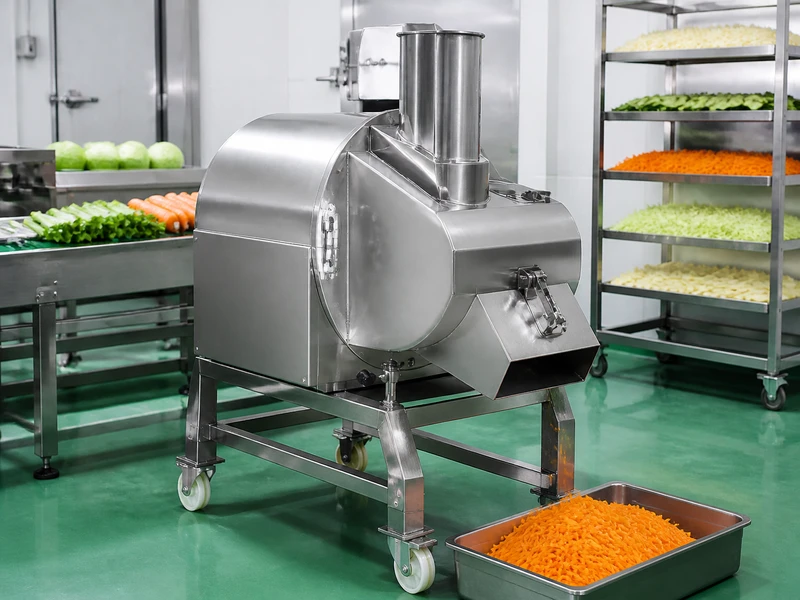
The High-Speed Sanitary Vegetable Shredding & Julienne Machine est rigoureusement fabriqué en acier inoxydable SUS304 certifié de qualité alimentaire, conforme aux directives européennes de sécurité Machines CE et aux normes d'hygiène ISO9001. Spécialement conçu pour les usines agroalimentaires et stations de conditionnement exigeant un service continu, une maintenance réduite et des économies d'énergie.
Points Forts d',
- Sanitary Design: Complete SUS304 construction with mirror-polished contact surfaces to prevent bacterial adhesion.
- Automation Control: Integrated Siemens/Schneider electrical components with digital PLC touchscreen interface.
- High Reliability: Heavy-duty motor and reduction gearbox engineered for continuous 24/7 industrial factory operations.
- Custom Engineering: Dimensions, voltage specifications (220V/380V/440V 50/60Hz), and connection flanges customizable to customer workshop layouts.